

Last updated: November 2026
You finished +2 Science, you like computers, and now you are stuck between two choices: BSc CSIT or BE Computer Engineering. Both are four-year degrees. Both lead to IT jobs. So what is the real difference?
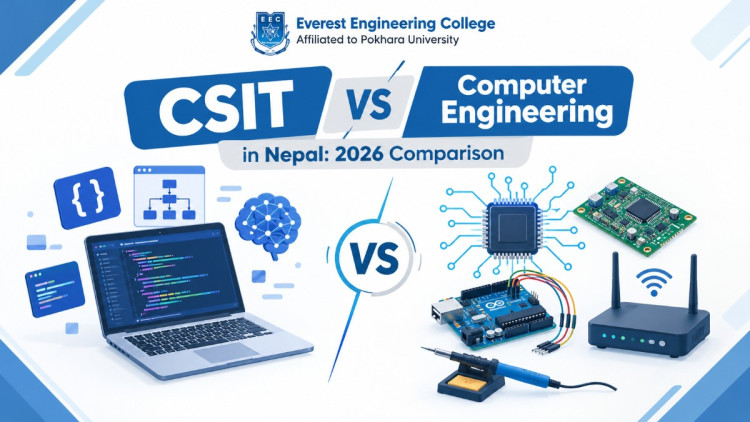
Here is the short answer. BSc CSIT is a computer science degree from Tribhuvan University that focuses on software, programming and theory. BE Computer Engineering is an engineering degree that covers both software and hardware, and it lets you take the Nepal Engineering Council licence exam. Choose CSIT if you only want software. Choose BE Computer if you want software plus hardware, networks and an engineering title.
This guide compares the two side by side: eligibility, subjects, entrance exams, careers and salary.
| Point | BSc CSIT | BE Computer Engineering |
|---|---|---|
| Degree type | Bachelor of Science | Bachelor of Engineering |
| University | Tribhuvan University (IOST) | TU (IOE), Pokhara University, Kathmandu University, Purbanchal University |
| Duration | 4 years, 8 semesters | 4 years, 8 semesters |
| Total credits | 126 credit hours | About 129 credits (Pokhara University, at EEC) |
| Main focus | Software, algorithms, programming, theory | Software plus hardware, electronics, networks and systems |
| Entrance pass mark | 35 out of 100, no negative marking | Depends on the university. IOE uses 10% negative marking |
| NEC engineering licence | Not an engineering degree | Yes, graduates can sit the NEC licence exam |
| Best for | Students who want pure software and coding | Students who want software, hardware and an engineering career |
BSc CSIT (Computer Science and Information Technology) is a four-year, eight-semester program run by Tribhuvan University's Institute of Science and Technology. Students complete 126 credit hours of computer science and allied courses.
Most of the credits go to core computer science: 75 credit hours. The rest covers maths, natural science, electives, English, social science and a 9-credit internship and project. You study subjects like C programming, data structures, algorithms, databases, networks, cryptography and artificial intelligence.
You can see the full course list on the Central Department of CSIT, Tribhuvan University website.
BE Computer Engineering is a four-year engineering degree offered by several universities in Nepal. It teaches software, but it also covers how computers are built and how they connect.
Along with programming, you study electronics, digital logic, microprocessors, computer architecture, embedded systems, and networks. You also take core engineering subjects like engineering maths, physics, drawing, and project management in the first years.
At Everest Engineering College, the BE Computer program under Pokhara University has 129 credits over 8 semesters. For a full overview of the field, read our guide to computer engineering in Nepal.
Both programs require Physics and Mathematics, but the rules differ a little.
The key difference is Chemistry. BE programs check your Chemistry marks, while CSIT eligibility focuses on Physics and Maths. If you are a Biology student, read our guide to engineering after 12th Biology in Nepal.
Both degrees need an entrance exam, but the format is not the same.
Tip: you can sit both exams. Many students apply to CSIT and BE in the same year to keep their options open.
This is the biggest difference between the two degrees.
CSIT goes deeper into computer science theory. You get more time on algorithms, theory of computation, data structures, cryptography and electives like machine learning or web technology.
BE Computer goes wider. You spend time on circuits, electronics, microprocessors, instrumentation and embedded systems. This helps if you want to work with IoT, robotics, networking hardware or telecom.
Neither is "harder" in general. CSIT is heavier on logic and theory. BE is heavier on engineering maths, physics and lab work.
In the software industry, both degrees compete for the same jobs: software developer, web developer, QA engineer, data analyst, DevOps and cloud roles. Employers mostly look at your skills and projects, not your degree name.
The difference shows up in engineering roles. BE graduates can sit the licence exam of the Nepal Engineering Council (NEC). Since 2022, Nepali law requires engineers to hold an NEC licence to practise engineering. This matters for jobs that need a registered engineer, such as some government posts, telecom, and network or hardware projects.
So if you only want to build software, CSIT is enough. If you want the option to work as a licensed engineer later, BE Computer keeps that door open.
In software jobs, there is no big salary gap between the two degrees. A strong CSIT graduate and a strong BE Computer graduate usually start in a similar range. Your pay grows with skills like cloud, DevOps, cybersecurity and AI, not with your degree title.
BE Computer graduates may have an edge in engineering-specific roles and government engineering posts. For real numbers by role and experience, see our computer engineering salary in Nepal guide.
Use this simple checklist:
There is no wrong choice. Both degrees can lead to a great tech career in Nepal or abroad. Pick the one that matches what you enjoy learning.
Everest Engineering College (EEC) in Sanepa, Lalitpur has offered engineering programs under Pokhara University since 2001. Alongside BE Computer, it runs BE IT, BE Software and BE Civil, plus a Master's in Computer Engineering.
Students from both the Physical and Biological groups can apply if they studied Physics, Chemistry and Maths with at least 45% or a C grade in each. Scholarships include government, outstanding performance, class topper and admission scholarships. See the admission criteria and scholarships, read our admission guide for 2026/27, or call the admission office on 01-5420742.
Neither is better for everyone. CSIT suits students who want pure software and computer science theory. BE Computer suits students who want software plus hardware and the option of an NEC engineering licence.
Yes. Software companies hire CSIT and BE Computer graduates for the same developer, QA, data and DevOps roles. Employers mostly look at skills and projects, not the degree name.
They are hard in different ways. CSIT is heavier on algorithms and theory, while BE Computer is heavier on engineering maths, physics, electronics and lab work.
Yes for both, if they studied Mathematics of 100 marks. CSIT needs Physics and Maths of 100 marks each, and BE needs Physics, Chemistry and Maths with at least 45% or a C grade in each.
In software jobs, starting pay is usually similar. Skills like cloud, DevOps, cybersecurity and AI matter more than the degree. BE graduates may have an edge in engineering and government engineering roles.
BE Computer covers both hardware and software. BE IT focuses more on software, networks and information systems while still being an engineering degree.